Note on older research: This article was published before 2022. The technical breakdown remains accurate, though external links or tools mentioned may have changed.
Loaders nowadays are part of the malware landscape and it is common to see on sandbox logs results with "loader" tagged on. Specialized loader malware like Smoke or Hancitor/Chanitor are facing more and more with new alternatives like Godzilla loader, stealers, miners and plenty other kinds of malware with this developed feature as an option. This is easily catchable and already explained in earlier articles that I have made.
Since a few months, another dedicated loader malware appears from multiple sources with the name of "Proton Bot" and on my side, first results were coming from a v0.30 version. For this article, the overview will focus on the latest one, the v1.
Sold 50$ (with C&C panel) and developed in C++, its cheaper than Smoke (usually seen with an average of 200$/300$) and could explain that some actors/customers are making some changes and trying new products to see if it's worth to continue with it. The developer behind (glad0ff), is not as his first malware, he is also behind Acrux (retired tracker page) & Decrux.
[Disclaimer: This article is not a deep in-depth analysis]
Something that I am finally glad by reversing this malware is that I'm not in pain for unpacking a VM protected sample. By far this is the "only one" that I've analyzed from this developer this is not using Themida, VMprotect or Enigma Protector.
So seeing finally a clean PE is some kind of heaven.
Behavior
When the malware is launched, it's retrieving the full path of the executed module by calling GetModuleFilename, this returned value is the key for Proton Bot to verify if this, is a first-time interaction on the victim machine or in contrary an already setup and configured bot. The path is compared with a corresponding name & repository hardcoded into the code that are obviously obfuscated and encrypted.
This call is an alternative to GetCommandLine on this case.
On this screenshot above, EDI contains the value of the payload executed at the current time and EAX, the final location. At that point with a lack of samples in my possession, I cannot confirm this path is unique for all Proton Bot v1 or multiple fields could be a possibility, this will be resolved when more samples will be available for analysis...
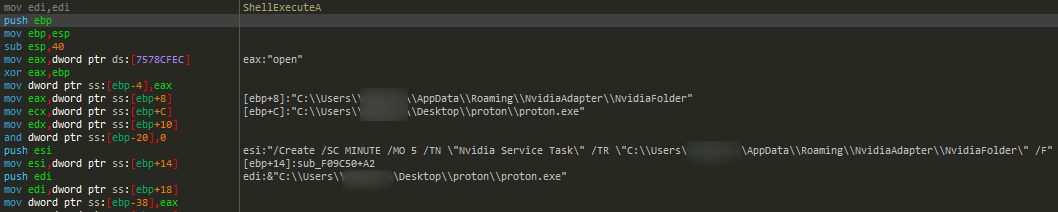
Next, no matter the scenario, the loader is forcing the persistence with a scheduled task trick. Multiple obfuscated blocs are following a scheme to generating the request until it's finally achieved and executed with a simple ShellExecuteA call.
With a persistence finally integrated, now the comparison between values that I showed on registers will diverge into two directions :
If paths are different
Making an HTTP Request on "http://iplogger.org/1i237a" for grabbing the Bot IP
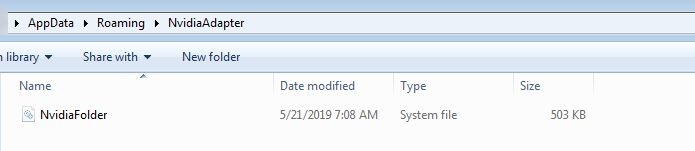
Creating a folder & copying the payload with an unusual way that I will explain later.
Executing proton bot again in the correct folder with CreateProcessA
Exiting the current module
if paths are identical
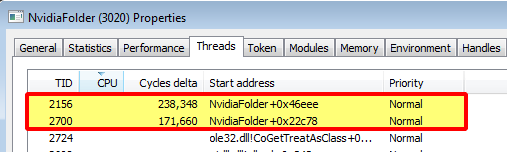
two threads are created for specific purposes
one for the loader
the other for the clipper
At that point, all interactions between the bot and the C&C will always be starting with this format :
/page.php?id=%GUID%
%GUID% is, in fact, the Machine GUID, so on a real scenario, this could be in an example this value "fdff340f-c526-4b55-b1d1-60732104b942".
Summary
Mutex
dsks102d8h911s29
Loader Path
%APPDATA%/NvidiaAdapter
Loader Folder
Schedule Task
Process
A unique way to perform data interaction
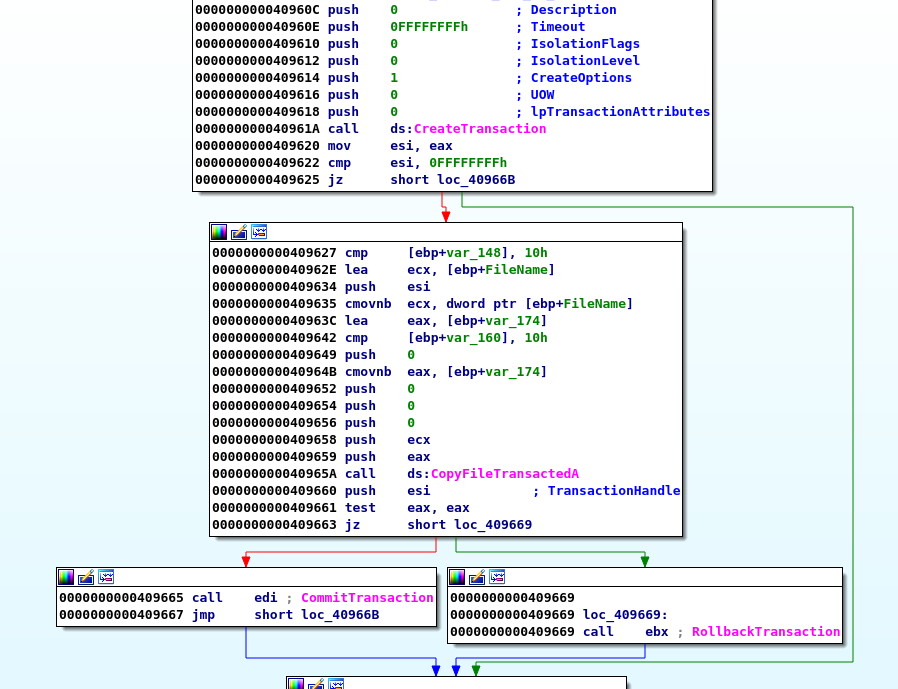
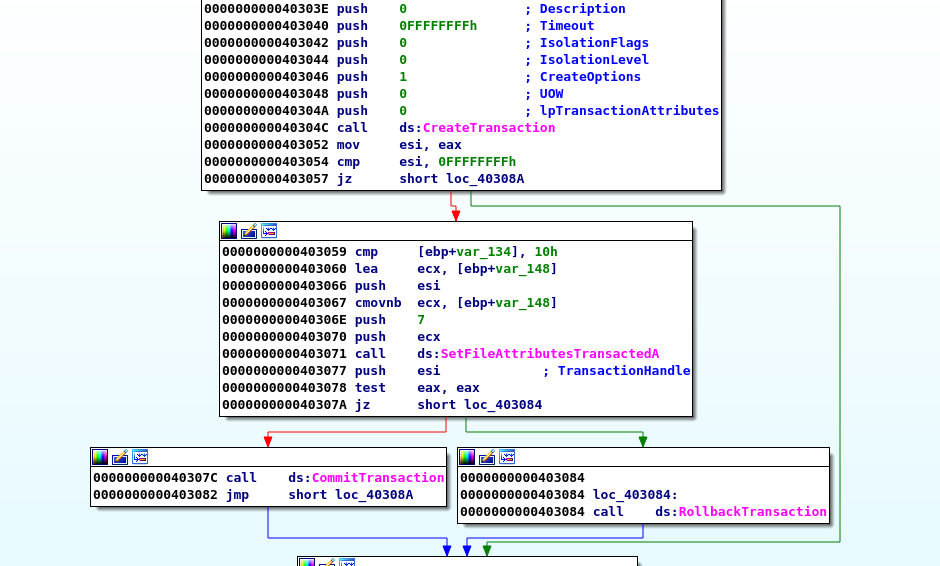
This loader has an odd and unorthodox way to manipulate the data access and storage by using the Windows KTM library. This is way more different than most of the malware that is usually using easier ways for performing tasks like creating a folder or a file by the help of the FileAPI module.
The idea here, it is permitting a way to perform actions on data with the guarantee that there is not even a single error during the operation. For this level of reliability and integrity, the Kernel Transaction Manager (KTM) comes into play with the help of the Transaction NTFS (TxF).
For those who aren't familiar with this, there is an example here :
This different way to interact with the Operating System is a nice way to escape some API monitoring or avoiding triggers from sandboxes & specialized software. It's a matter time now to hotfix and adjusts this behavior for having better results.
The API used has been also used for another technique with analysis of the banking malware Osiris by @hasherezade
Anti-Analysis
There are three main things exploited here:
Stack String
Xor encryption
Xor key adjusted with a NOT operand
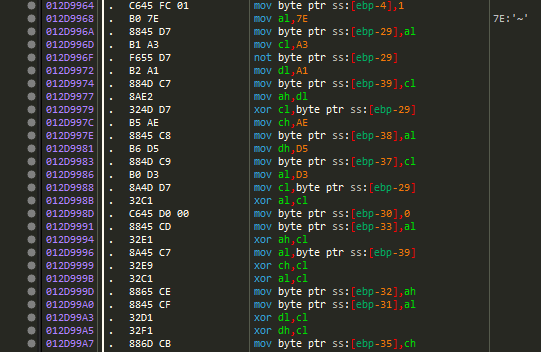
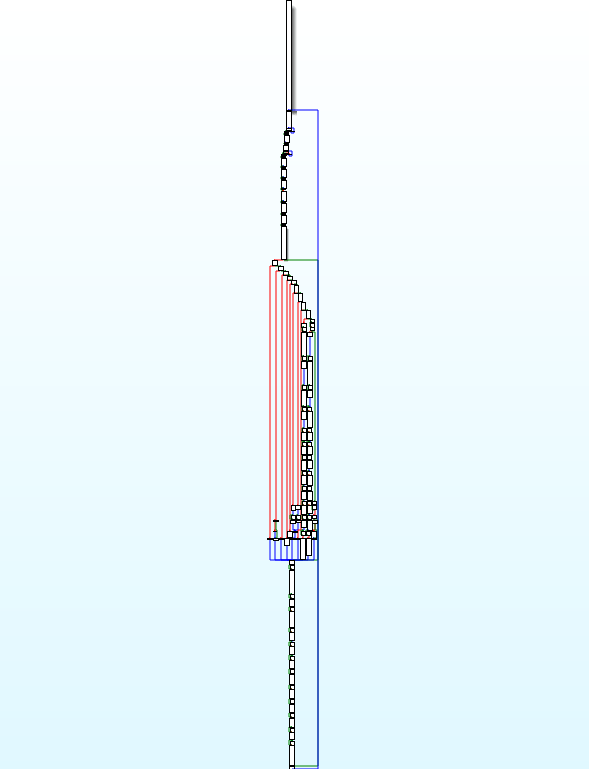
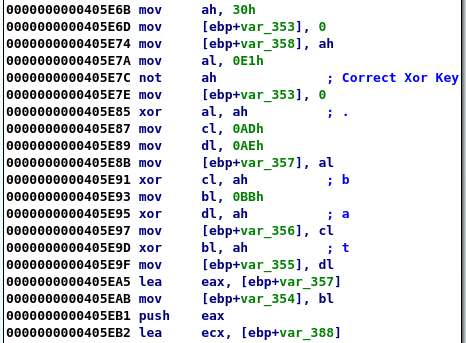
By guessing right here, with the utilization of stack strings, the main ideas are just to create some obfuscation into the code, generating a huge amount of blocks during disassembling/debugging to slow down the analysis. This is somewhat, the same kind of behavior that Predator the thief is abusing above v3 version.
The screenshot as above is an example among others in this malware about techniques presented and there is nothing new to explain in depth right here, these have been mentioned multiple times and I would say with humor that C++ itself is some kind of Anti-Analysis, that is enough to take some aspirin.
Loader Architecture
The loader is divided into 5 main sections :
Performing C&C request for adding the Bot or asking a task.
Receiving results from C&C
Analyzing OpCode and executing to the corresponding task
Sending a request to the C&C to indicate that the task has been accomplished
The task format is really simple and is presented as a simple structure like this.
Task Name;Task ID;Opcode;Value
Tasks OpCodes
When receiving the task, the OpCode is an integer value that permits to reach the specified task. At that time I have count 12 possible features behind the OpCode, some of them are almost identical and just a small tweak permits to differentiate them.
OpCode
Feature
1
Loader
2
Self-Destruct
3
Self-Renewal
4
Execute Batch script
5
Execute VB script
6
Execute HTML code
7
Execute Powershell script
8
Download & Save new wallpaper
9
???
10
???
11
???
12 (Supposed)
DDoS
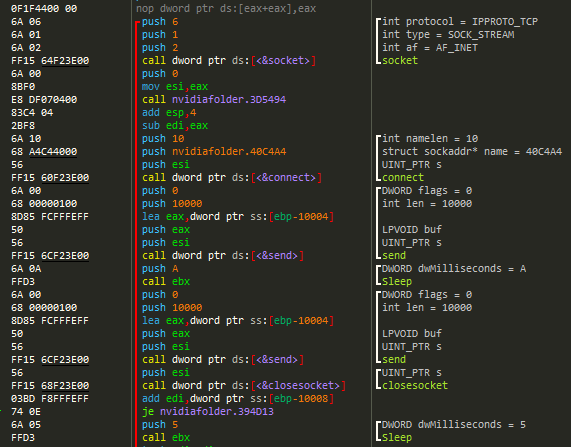
For those who want to see how the loader part looks like on a disassembler, it's quite pleasant (sarcastic)the joy of C++
Loader main task
The loader task is set to the OpCode 1. in real scenario this could remain at this one :
Clipper fundamentals are always the same and at that point now, I'm mostly interested in how the developer decided to organize this task. On this case, this is simplest but enough to performs accurately some stuff.
The first main thing to report about it, it that the wallets and respective regular expressions for detecting them are not hardcoded into the source code and needs to perform an HTTP request only once on the C&C for setting-up this :
/page.php?id=%GUID%&clip=get
The response is a consolidated list of a homemade structure that contains the configuration decided by the attacker. The format is represented like this:
[
  id,             # ID on C&C
  name,           # ID Name (i.e: Bitcoin)
  regex,          # Regular Expression for catching the Wallet
  attackerWallet  # Switching victim wallet with this one
]
At first, I thought, there is a request to the C&C when the clipper triggered a matched regular expression, but it's not the case here.
On this case, the attacker has decided to target some wallets:
Bitcoin
Dash
Litecoin
Zcash
Ethereum
DogeCoin
if you want an in-depth analysis of a clipper task, I recommend you to check my other articles that mentioned in details this (Megumin & Qulab).
DDos
Proton has an implemented layer 4 DDoS Attack, by performing spreading the server TCP sockets requests with a specified port using WinSocks
Executing scripts
The loader is also configured to launch scripts, this technique is usually spotted and shared by researchers on Twitter with a bunch of raw Pastebin links downloaded and adjusted to be able to work.
Deobfuscating the selected format (.bat on this case)
There is a possibility to change the wallpaper of bot, by sending the OpCode 8 with an indicated following image to download. The scenario remains the same from the loader main task, with the exception of a different API call at the end
Setup the downloaded directory on %TEMP% with GetTempPathA
I can't understand clearly the utility on my side but surely has been developed for a reason. Maybe in the future, I will have the explanation or if you have an idea, let me share your thought about it :)
Example in the wild
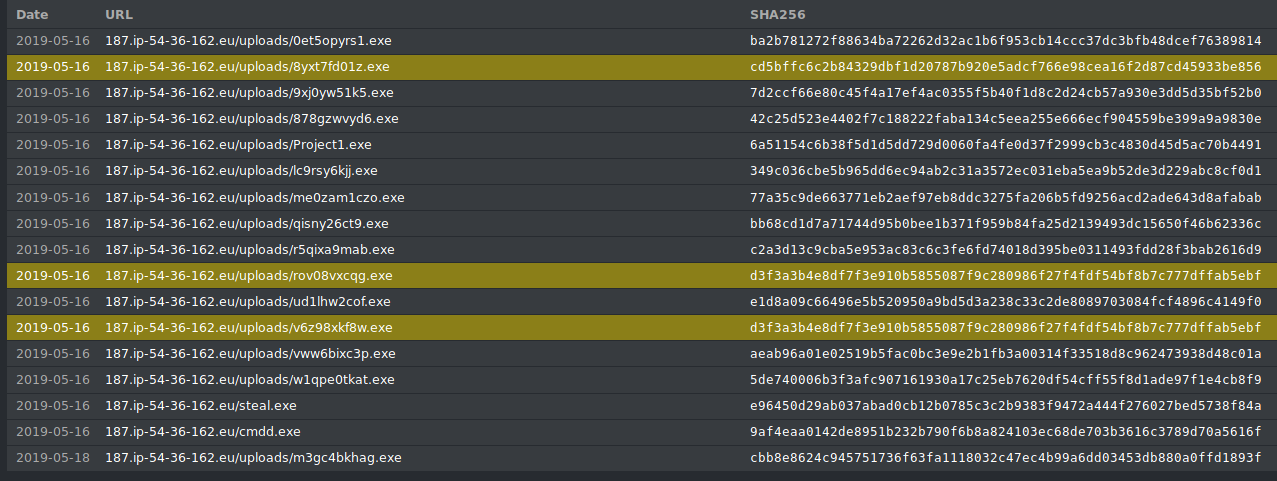
A few days ago, a ProtonBot C&C (187.ip-54-36-162.eu) was quite noisy to spread malware with a list of compatibilized 5000 bots. It's enough to suggest that it is used by some business already started with this one.
Notable malware hosted and/or pushed by this Proton Bot
There is also another thing to notice, is that the domain itself was also hosting other payloads not linked to the loader directly and one sample was also spotted on another domain & loader service (Prostoloader). It's common nowadays to see threat actors paying multiple services, to spread their payloads for maximizing profits.
All of them were accessible on the malware tracker (now retired).
[*] Yellow means duplicate hashes in the database.
Young malware means fresh content and with time and luck, could impact the malware landscape. This loader is cheap and will probably draw attention to some customers (or even already the case), to have less cost to maximize profits during attacks. ProtonBot is not a sophisticated malware but it's doing its job with extra modules for probably being more attractive. Let's see with the time how this one will evolve, but by seeing some kind of odd cases with plenty of different malware pushed by this one, that could be a scenario among others that we could see in the future.
On my side, it's time to chill a little.
Special Thanks - S!ri & Snemes
Under your Yaris strings I see "build.pdb". Does that mean they actually included debugging information in your sample?
fumko
on this case, it's just a hardcoded string from the PE due to the compiler option.
And because this file is not present (obviously), you will not see the debugging information.
Comments are archived. Get in touch if you have a question.
 On this screenshot above, EDI contains the value of the payload executed at the current time and EAX, the final location. At that point with a lack of samples in my possession, I cannot confirm this path is unique for all Proton Bot v1 or multiple fields could be a possibility, this will be resolved when more samples will be available for analysis...
Next, no matter the scenario, the loader is forcing the persistence with a scheduled task trick. Multiple obfuscated blocs are following a scheme to generating the request until it's finally achieved and executed with a simple ShellExecuteA call.
 With a persistence finally integrated, now the comparison between values that I showed on registers will diverge into two directions :
If paths are different


 The screenshot as above is an example among others in this malware about techniques presented and there is nothing new to explain in depth right here, these have been mentioned multiple times and I would say with humor that C++ itself is some kind of Anti-Analysis, that is enough to take some aspirin.
 Notable malware hosted and/or pushed by this Proton Bot
 All of them were accessible on the malware tracker (now retired).
[*] Yellow means duplicate hashes in the database.
 Special Thanks - S!ri & Snemes
Reader comments 2
Comments are archived. Get in touch if you have a question.